Impact

Impact

Our Approach to Impact

At ACT Fund, impact is not an outcome—it is embedded in every investment.

Agricultural value chains can only be truly sustainable when they work for the people and ecosystems that sustain them. Across many commodity dependent regions, smallholder farmers remain exposed to unstable prices, weak market access, climate shocks, and land degradation. ACT Fund’s impact approach responds to this challenge by financing and supporting agri SMEs that can strengthen farmer livelihoods while adopting or promoting regenerative agricultural systems and practices.

Impact is therefore not treated as an add on to investment. It is embedded in how ACT selects opportunities, structures support, and measures progress over time. ACT’s impact strategy is built around Inclusive Regenerative Agriculture, or IRA, which places smallholder farmers at the centre of regenerative systems designed to restore soils, enhance biodiversity, build climate resilience, and improve rural livelihoods.

Theory of Change:

ACT’s Theory of Change starts from a simple premise: smallholder farmers often cannot capture the full value of what they produce because they face barriers to finance, technical support, and market access. Agri SMEs can help close that gap by linking farmers to higher value markets, providing services and inputs, and creating more stable and transparent supply chains. But to do so at scale, these businesses themselves need appropriate financing and capacity support. ACT responds by combining flexible debt financing with technical assistance to help investees grow in ways that are both inclusive and regenerative.

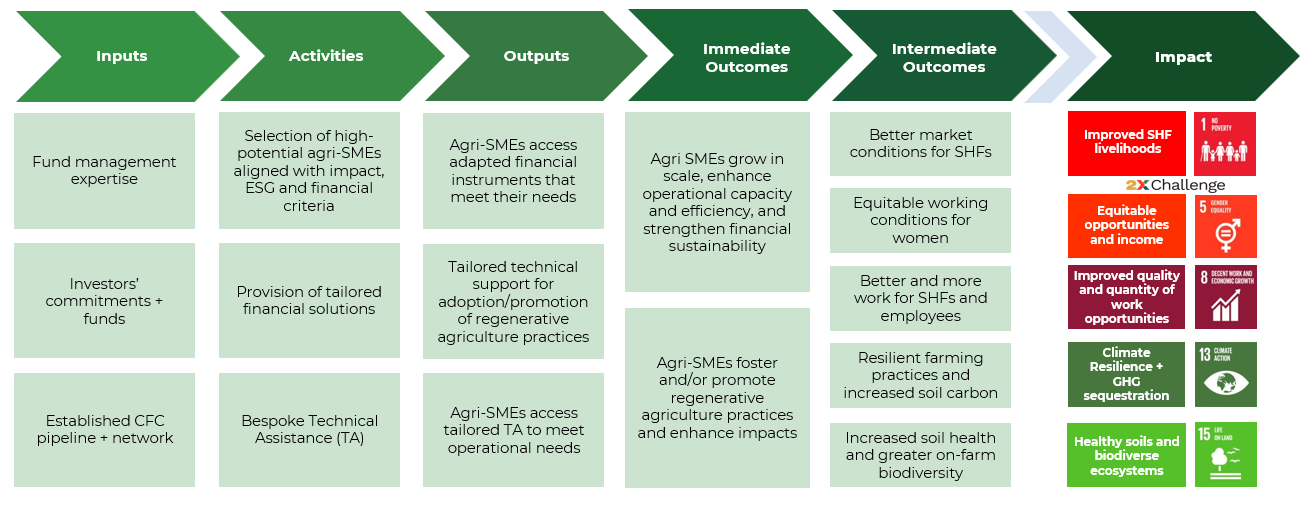
This approach is designed to create a chain of results. At the activity level, ACT finances and supports agri SMEs capable of scaling regenerative transitions. At the output level, this increases farmer access to knowledge, inputs, and regenerative practices. At the outcome level, it contributes to more stable incomes, improved soil fertility, greater resource efficiency, and stronger resilience to climate shocks. At the impact level, it supports improved livelihoods, environmental restoration, biodiversity enhancement, and climate mitigation and adaptation.

The Sustainable Development Goals as our Impact Framework

ACT’s impact strategy aligns with internationally recognised frameworks to ensure that impact is measured in a credible, transparent, and decision useful way. The Fund’s SDG Impact Framework focuses on five core Sustainable Development Goals where ACT can make direct and measurable contributions: SDG 1, SDG 5, SDG 8, SDG 13, and SDG 15.

These goals reflect ACT’s ambition to reduce poverty, advance gender equality, promote inclusive economic growth, strengthen climate action, and protect life on land. Together, they provide a shared language for understanding how investment in agri SMEs can support both farmer prosperity and ecosystem restoration.

ACT complements this SDG alignment with the use of IRIS+, the GIIN’s impact measurement framework. IRIS+ provides the Fund with a standardised taxonomy of indicators linked to the SDGs, allowing ACT to track social, economic, and environmental performance consistently across the portfolio while still capturing investee specific outcomes where relevant.

ACT also integrates a gender lens into its impact approach, including the use of 2X aligned indicators related to female beneficiaries, leadership, employment, and ownership. This helps ensure that women are not only counted among beneficiaries, but are supported as active participants and leaders in agricultural transformation.

What We Measure

ACT measures impact across its portfolio using the IRIS+ taxonomy, developed by the Global Impact Investing Network (GIIN). IRIS+ provides a globally recognised framework of standardised impact metrics linked to the Sustainable Development Goals, enabling ACT to measure results consistently and credibly across investments, while still adapting indicators to different value chains, geographies, and business models.

In practice, ACT uses IRIS+ to select, baseline, and monitor indicators for each investee. These indicators are chosen based on ACT’s impact thesis, its Theory of Change, and its core SDGs, then tailored to the specific context of the investment. This allows the Fund to aggregate portfolio wide results, while also capturing investee specific outcomes where relevant.

ACT’s impact measurement framework is organised across three interconnected dimensions:

Economic

ACT uses IRIS+ aligned indicators to track how investments strengthen livelihoods and rural economies. Core indicators include the number of agri-SMEs financed, number of smallholder farmers supported, and, where relevant, metrics related to enterprise growth and employment. Together, these indicators help ACT assess how investees are expanding market access, creating value locally, and strengthening the economic position of smallholder farmers.

Social

ACT uses IRIS+ indicators to measure the inclusiveness of its investments and the reach of its support to smallholder communities. Core indicators include the number of women smallholder farmers supported and the number of smallholder farmers receiving support for regenerative agriculture practices. These are complemented, where relevant, by 2X aligned indicators on female beneficiaries, female leadership, female employment, and female ownership, helping ACT track women’s economic participation more systematically across the portfolio.

Environmental

ACT uses IRIS+ aligned environmental indicators to measure the regenerative and climate related performance of its investments. Core indicators include hectares under cultivation and greenhouse gas emissions sequestered, which help ACT monitor how portfolio companies contribute to sustainable land use, improved soil health, and climate mitigation. ACT also sees the uptake of Inclusive Regenerative Agriculture practices as a key metric within its framework, because these practices directly link investment activity to environmental and livelihood outcomes.

By combining IRIS+ with its SDG framework, ACT translates its impact strategy into a practical monitoring system that supports accountability, comparability, and continuous learning across the investment cycle. The Fund uses these indicators not only to report on results, but also to guide due diligence, establish baselines, structure reporting templates, and monitor progress over time.

Portfolio Impact Targets

Over the Fund’s 10 year cumulative lifespan, ACT is targeting the following portfolio wide outcomes:

257670

smallholder farmers supported

235970

hectares cultivated

103040

women smallholder farmers supported

1174500

greenhouse gas emissions sequestered

128800

smallholder farmers receiving support for regenerative agriculture practices

These targets reflect the scale of ACT’s intended contribution across livelihoods, gender inclusion, land use, and

climate impact over the life of the Fund.